

The most important pickleball paddle specs are approval status, weight and balance, shape, handle length and grip size, face material, core construction, and thickness. No single specification proves that a paddle will create more power, spin, control, or comfort for every player. The right buying process starts with where you will play, then narrows options by fit and on-court response.
This plain-English pickleball paddle buying guide explains what the labels can tell you, what they cannot, how to compare paddles without marketing shortcuts, and where DOPE’s High Roller fits honestly as a style-first recreational model.
1. Check Tournament Approval Before Any Other Spec
If you plan to play a USA Pickleball-sanctioned event, begin with eligibility. Search the exact brand and model on the USA Pickleball Approved Paddle List. Do not rely on an old product image, marketplace description, logo, or a seller’s general statement about the brand.
Status can be model-specific and may change, so check again near the event date. Recreational facilities and unsanctioned leagues can set their own equipment policies. Ask the organizer when the rules are unclear.
2. Static Weight Is Only Part of Maneuverability
Listed weight tells you the paddle’s total mass, often within a manufacturing range. It does not fully describe how the paddle moves. Two paddles with the same scale weight can feel different when one carries more mass toward the head and the other is more handle-balanced.
What a lighter-feeling paddle may offer
- quicker preparation in hand battles;
- easier repositioning for body shots;
- less effort during repeated acceleration for some players.
What a heavier or head-heavier feel may offer
- more perceived stability at contact;
- more momentum through a full swing;
- a slower but sometimes steadier response.
These are tendencies, not guarantees. Technique, timing, construction, and individual strength affect the result. Overgrips, edge tape, and added weights also change total mass and balance. If you have pain, prior injury, or unusual fatigue, seek individualized guidance rather than treating a generic weight category as medical advice.
3. Match Paddle Shape to Contact and Court Coverage
Manufacturers use different names, but most paddles fall into broad shape families.
| Shape family | Common characteristic | What to test |
|---|---|---|
| Widebody | More width across the face | Comfort on off-center contacts and speed at the body |
| Standard or hybrid | Middle ground between width and length | Overall balance for drives, volleys, and two-handed shots |
| Elongated | More length and reach, usually with less width | Tip speed, maneuverability, and contact consistency |
Longer is not automatically better. Added reach has little value if the player is consistently late in fast exchanges or misses the preferred contact area. Compare the shape using the shots you actually play.
4. Choose Handle Length and Grip Size Together
Handle length changes how much room you have for two hands, how high the grip can sit, and how much of the paddle’s total dimensions remain for the face. A longer handle can help a two-handed backhand setup; a shorter handle can suit a compact one-handed style.
Grip circumference affects finger spacing and how easily the hand changes position. There is no single correct size for every player. Test whether you can:
- hold the paddle without squeezing excessively;
- maintain a stable face on blocks and dinks;
- change between forehand and backhand preparation comfortably;
- fit a second hand if you use a two-handed backhand;
- add an overgrip without making the handle too large.
Handle shape and butt-cap profile also affect comfort even when two listed grip sizes match.
5. Face Material Does Not Tell the Whole Performance Story
Common labels include fiberglass, carbon fiber, raw carbon fiber, graphite, and composites. These descriptions identify part of the build, but they do not independently predict the complete feel. Resin, layup, surface process, core, shape, mass distribution, and manufacturing consistency all matter.
Carbon-fiber labels
Players often describe some carbon-faced paddles as muted or controlled, but “carbon” is a broad category. Terms such as 3K, T700, woven, or unidirectional describe fibers or arrangements; they are not universal performance grades that let you rank any two finished paddles.
Fiberglass and composite labels
Some players experience fiberglass-faced paddles as lively, but construction differences can outweigh the label. “Composite” may refer to several layers or materials and needs more context.
Surface texture and spin
A textured face can influence friction, but a visual pattern is not proof of legal or lasting spin performance. If competition eligibility matters, use the approved list rather than interpreting texture by touch.
6. Core Material and Thickness Affect Feel—but Not in Isolation
Polymer honeycomb has long been common, while foam and hybrid constructions are increasingly visible. Core-cell size, density, perimeter construction, bonding, and face layup all shape the final response.
Thickness
Paddle thickness is often discussed as a simple control-versus-power scale. That shortcut is too broad. A thicker build may feel softer or more stable in some models, while a thinner build may feel more direct, but two paddles of the same thickness can play differently.
Use thickness as a filter, then test:
- how the ball responds on a centered dink;
- how stable the face feels on a hard volley;
- whether the paddle launches a reset higher than expected;
- how easily you accelerate it on a serve or drive;
- how forgiving off-center contact feels to you.
Thermoformed, foam-injected, and unibody claims
These terms describe manufacturing approaches, not guaranteed outcomes. Ask what the construction changes in the specific model and look for objective eligibility information when relevant. Avoid assuming every thermoformed paddle is more powerful or every foam feature creates the same response.
7. Test the Paddle With a Repeatable Sequence
A demo is more useful when every paddle receives the same test. Use the same ball model, court, and target order when possible.
- Ten straight dinks: note launch, depth, and face stability.
- Ten crosscourt dinks: evaluate angle and off-center response.
- Ten blocks or resets: notice whether the ball rebounds higher or lower than intended.
- Ten volleys: test preparation speed and body-ball control.
- Ten serves: evaluate swing comfort, depth, and direction.
- Ten drives: note timing and balance rather than maximum speed.
- Five minutes of live play: see whether the paddle remains predictable under random pressure.
Record observations instead of declaring a winner after one clean shot. The best choice is the paddle whose response you can predict across the shots that matter to your game.
Pickleball Paddle Buying Checklist
- Is this exact brand and model approved for the events I plan to enter?
- Does the listed weight include a range?
- Where does the balance feel concentrated?
- Can I prepare quickly for a body volley?
- Does the handle fit one- or two-handed technique?
- Will an overgrip change the fit substantially?
- Does the shape match my reliable contact area?
- Can I control dinks, blocks, serves, and drives in the same demo?
- What warranty, return, or demo terms apply?
- Am I buying for sanctioned competition, recreational play, collecting, or visual style?
For a first-paddle decision with a simpler beginner focus, read how to choose your first pickleball paddle. This guide is the deeper specification reference.
Where the DOPE High Roller Fits
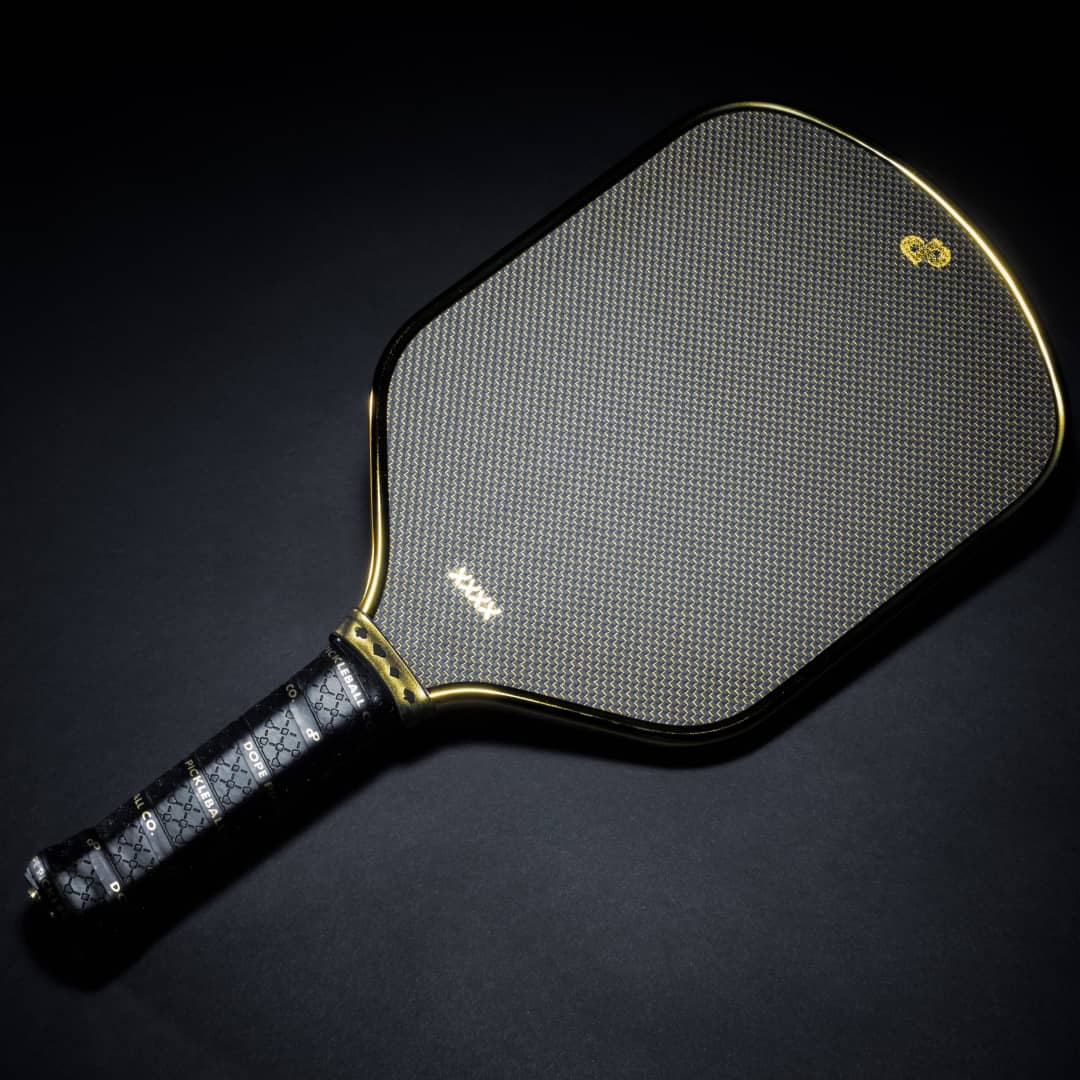
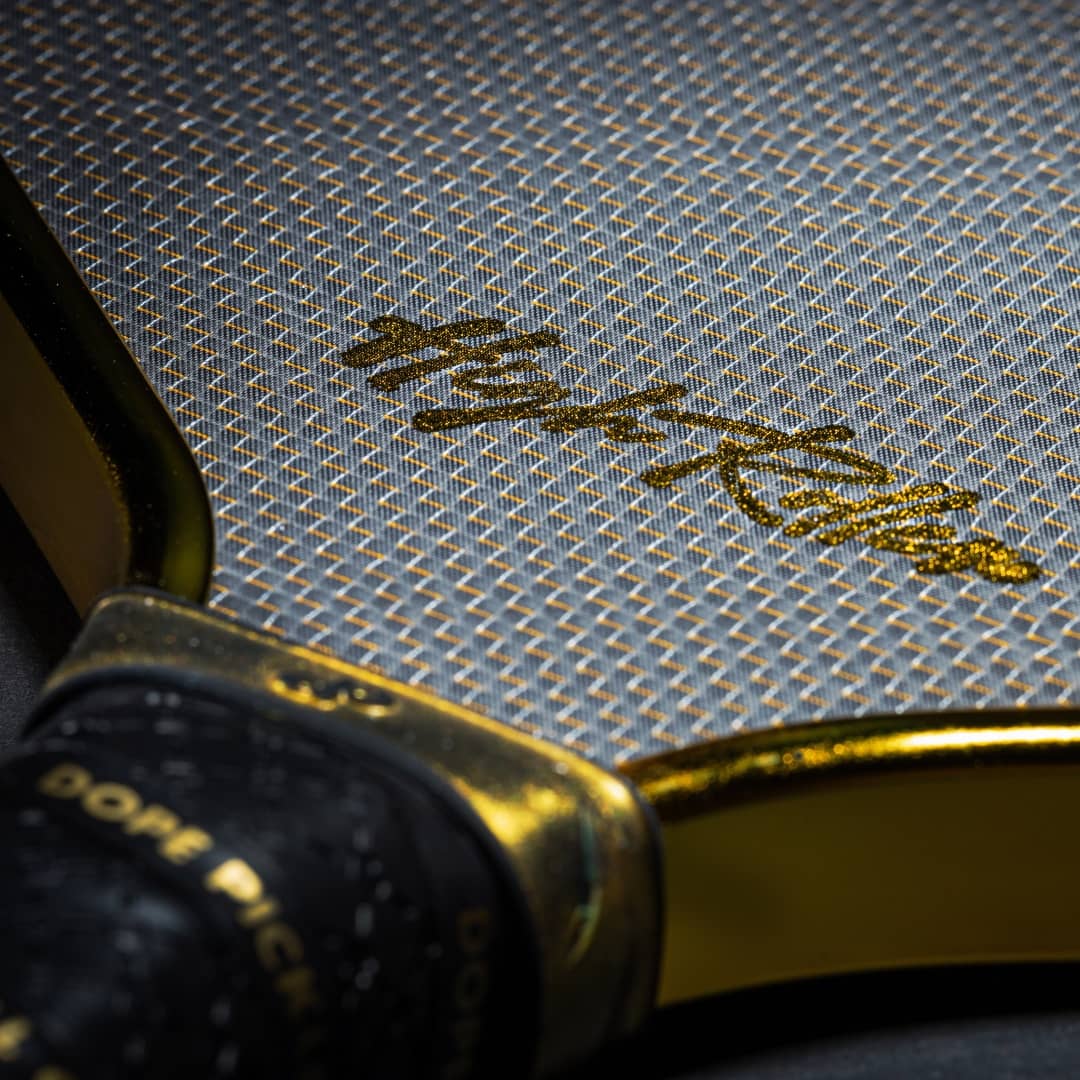
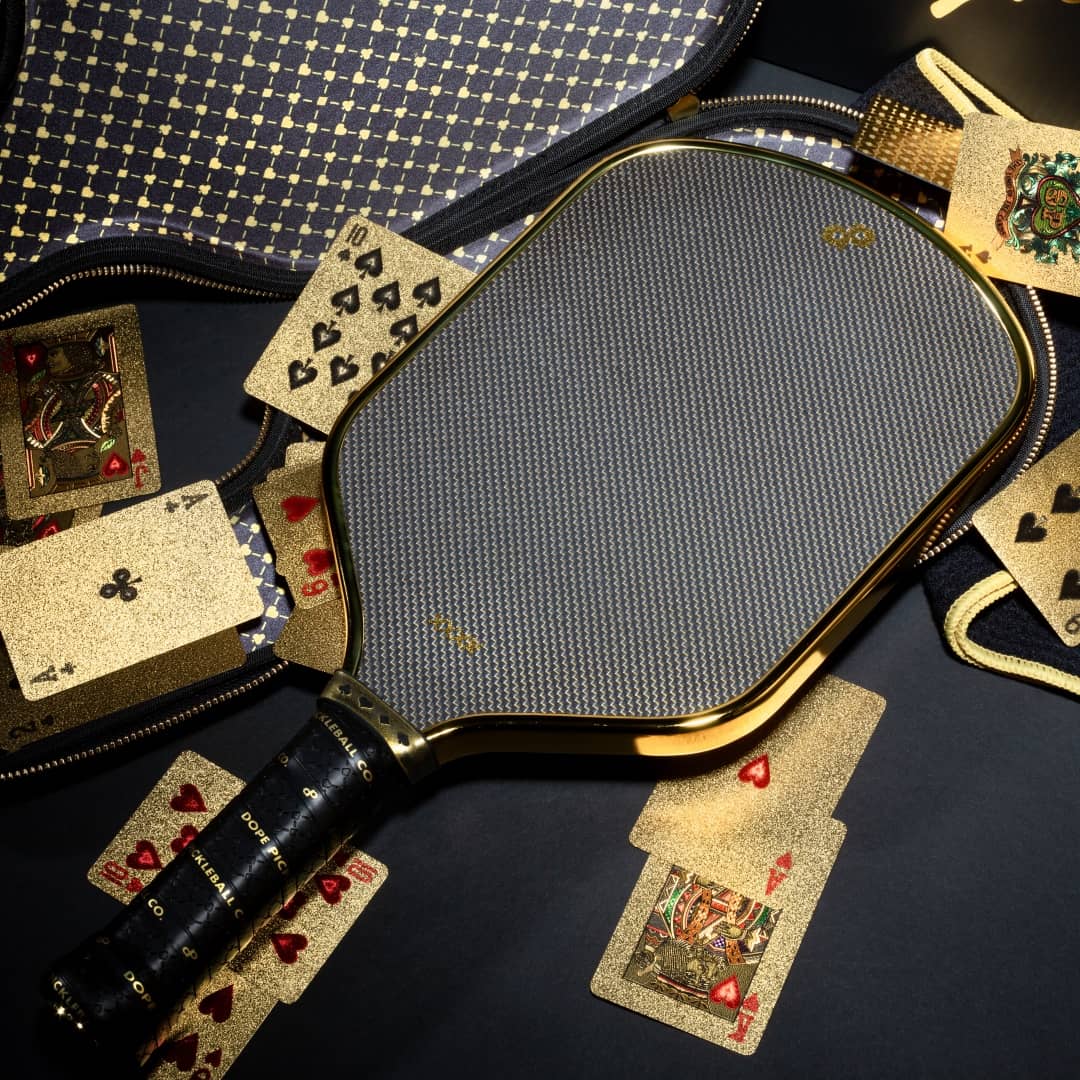
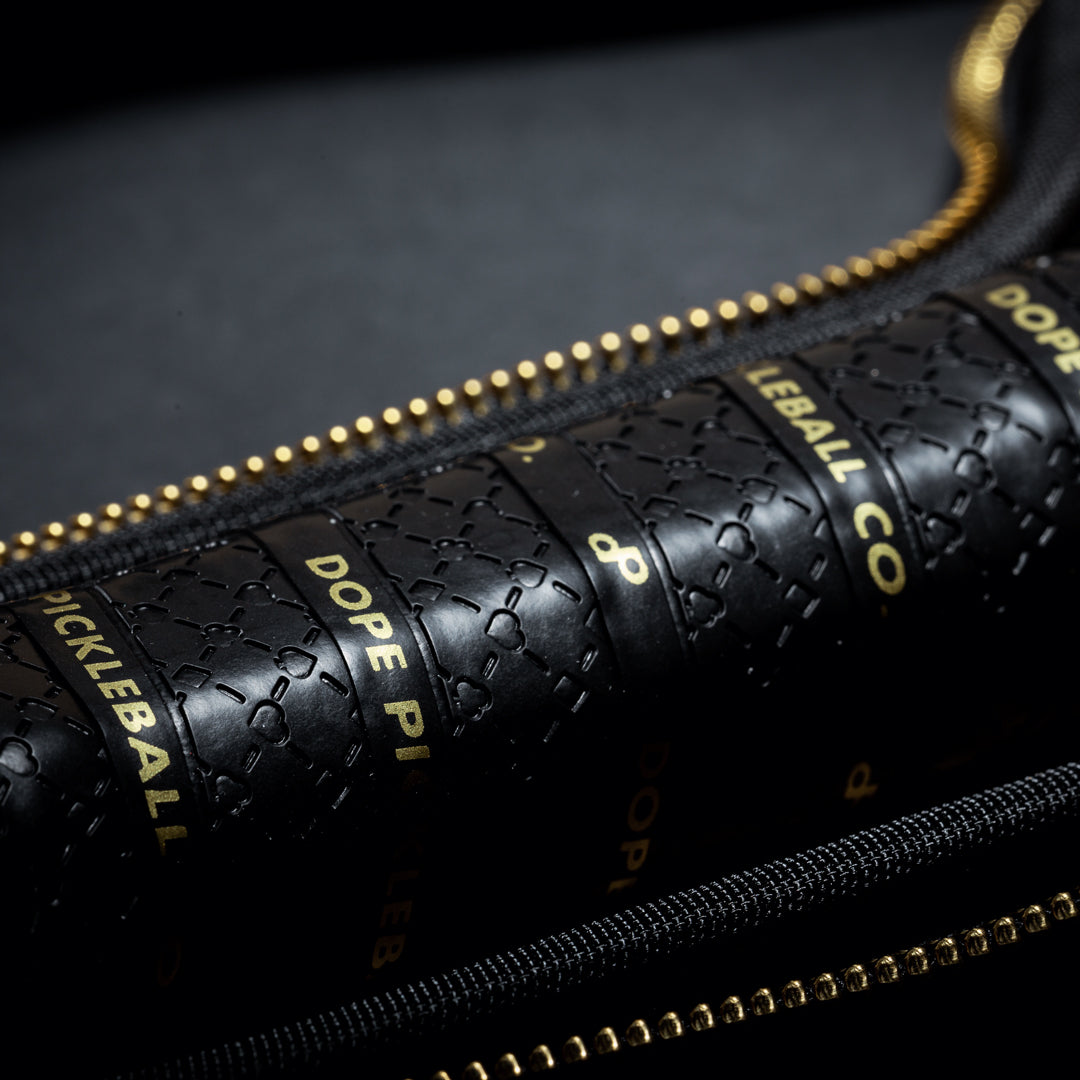
The High Roller Pickleball Paddle is the chrome-gold visual centerpiece of DOPE’s black-and-gold collection. Its product imagery highlights the reflective gold face, branded handle details, and coordinated presentation.
Choose it because you want that style for recreational or unsanctioned play where permitted. Do not choose it on the assumption that it is sanctioned-event eligible: the High Roller is not USA Pickleball approved. The High Roller Paddle Travel Case, Gold Glitter-Infused Ball 4-Pack, and High Roller Club Bundle extend the same collection aesthetic.
DOPE product pages should be your source for current availability and exact included items. This guide deliberately avoids hardcoding a price because pricing and inventory can change.
Frequently Asked Questions
What pickleball paddle specs matter most?
Approval status, weight and balance, shape, handle and grip fit, face construction, core, and thickness matter most when considered together.
Is a 14 mm or 16 mm pickleball paddle better?
Neither thickness is universally better. Thickness can influence feel, but construction, shape, mass distribution, and individual timing also matter.
Is carbon fiber always better than fiberglass?
No. Face material is only one part of the build, and different players prefer different launch, feedback, stability, and handling.
What paddle weight is best for beginners?
There is no universal beginner weight. Test a manageable range and prioritize comfortable preparation, stable contact, and repeatable technique.
Is the DOPE High Roller paddle USA Pickleball approved?
No. It is intended for recreational or unsanctioned play where permitted. Use the official approved-paddle list for sanctioned competition.


Share:
Doubles Pickleball Strategy: Build a Winning Partner System
7 Pickleball Dink Drills for Control, Movement & Decisions