


A third-shot drop is a soft, arcing ball played by the serving team after the serve and return, usually toward the opponents’ kitchen. Its purpose is to remove attack height and create a chance to move forward. It is important, but it is not mandatory on every third shot; return depth, contact quality, opponent position, and your team’s strengths should decide between a drop, drive, lob, or higher-margin response.
This guide explains third-shot drop mechanics, trajectory, targets, footwork, partner movement, common misses, and a measurable progression from short court to baseline.
Why the Third-Shot Drop Exists
The two-bounce rule shapes the opening of a rally. The receiving team lets the serve bounce, returns it, and often moves toward the kitchen. The serving team must let the return bounce, which commonly leaves it deeper in the court while the opponents hold a stronger forward position.
A hard third ball can work, especially against a short or high return, but two prepared players at the kitchen may block or counter it. A successful drop descends into the non-volley zone so the opponents contact at or below net height. That can create time for the serving team to advance.
The drop’s value is positional. It does not need to be a winner, and the serving team does not need to reach the kitchen in one move.
Third-Shot Drop or Third-Shot Drive?
| Return situation | Possible choice | Team intention |
|---|---|---|
| Deep return with balanced contact | Drop or controlled drive | Create a playable fifth shot |
| Short, high return | Controlled drive or aggressive placement | Pressure feet or open space |
| Deep return under pressure | Higher-margin drop, drive, or neutral ball | Stay in the rally before advancing |
| Opponents late to kitchen | Deep ball at moving feet | Keep them in transition |
| Opponents established and balanced | Drop with intentional target | Remove obvious attack height |
A drive-drop combination is common: drive the third to create a shorter block, then drop the fifth. The correct choice is the one your team can execute from the incoming ball.
Third-Shot Drop Mechanics
1. Move the feet before the swing
Deep returns create spacing pressure. Use adjustment steps so the ball is not crowded or contacted while falling backward. Establish a stable base that permits a smooth forward-and-upward path.
2. Prepare compactly
A drop needs controlled acceleration, not a full drive backswing. Set the paddle behind and below the expected contact without wrapping it around the body.
3. Contact in front
Leave space between the elbow and torso. Contact too late can open the face or send the ball across the body. Contact too far ahead can pull the target and reduce lift.
4. Lift through the ball
Use a smooth path that carries the ball upward with enough forward energy to reach the target. Avoid stabbing, scooping abruptly with the wrist, or decelerating before contact.
5. Finish toward the target
The finish should remain compact and balanced. A large follow-through can add unwanted pace; stopping at contact can send the ball into the net.
Some players use an open stance, others step through, and others use a hybrid base. Choose the footwork that produces repeatable spacing and recovery within your abilities.
Height, Apex, and Descent
The old instruction “peak just above the net” is often too risky. A drop can travel safely above the tape if its apex occurs early enough and the ball descends below attack height at the opponent.
Think in three points:
- Launch: enough upward path to clear the net.
- Apex: commonly on your side or near the net so descent begins before the opponent.
- Landing/contact zone: a ball that makes the opponent reach forward or contact low.
A drop that lands near the kitchen line is not automatically better than a shorter one. Deep placement can crowd feet, but excess depth can sit up. Shorter placement can pull an opponent forward, but excess height can invite an attack. Judge the opponent’s contact, not only the bounce location.
Choose a Third-Shot Drop Target
Middle
The middle increases court margin, can reduce angles, and may test partner ownership. It is a strong default under pressure.
Crosscourt
The diagonal court provides more distance and can move an opponent. It also opens an angle if the ball is too high.
Backhand-side foot
A target near a particular foot or hip can crowd a preferred stroke, but avoid tiny targets until overall height and depth are reliable.
Moving opponent
If one player is late reaching the kitchen, a lower ball at the feet can preserve that positional pressure. Do not force a delicate short drop when a simpler deep ball is available.
What to Do After the Drop
Read the ball before advancing.
- Low and descending: move forward together.
- Uncertain height: take available ground, then split step.
- High and attackable: hold, defend, or give space.
- Good drop returned softly: continue with a fifth-shot drop or reset.
The partner should not race ahead without the hitter. Both players need to recognize green, yellow, or red and maintain connected spacing.
Fix Common Third-Shot Drop Misses
Into the net
Add trajectory, ensure the stroke continues through contact, and check whether the ball was crowded. A larger target is better than aiming at the tape.
Too high
Check an overly open face, abrupt lift, late contact, or a swing that adds too much upward speed. Reduce pace and move the apex earlier.
Too deep
Shorten the forward finish, reduce launch speed, or move closer during practice until the feel becomes repeatable.
Too short
Keep the motion flowing through contact, improve spacing, and use more leg and shoulder contribution rather than a late wrist push.
Correct drop, poor transition
If the shot works but the team remains at the baseline, add a movement call and first-step goal to every repetition.
Four-Stage Third-Shot Drop Practice
- Kitchen to kitchen: rehearse stable face and arc with cooperative dinks.
- Transition distance: drop from midcourt to a large kitchen target.
- Baseline feeds: alternate comfortable and deep returns.
- Live first five: serve, return, third, fourth, and fifth with partner movement.
Use sets of ten and track net clears, low opponent contacts, and balanced first steps separately. Do not demand an arbitrary “eight out of ten” before moving; increase difficulty when the current level remains repeatable and safe.
Practice With Exact DOPE Product Photography
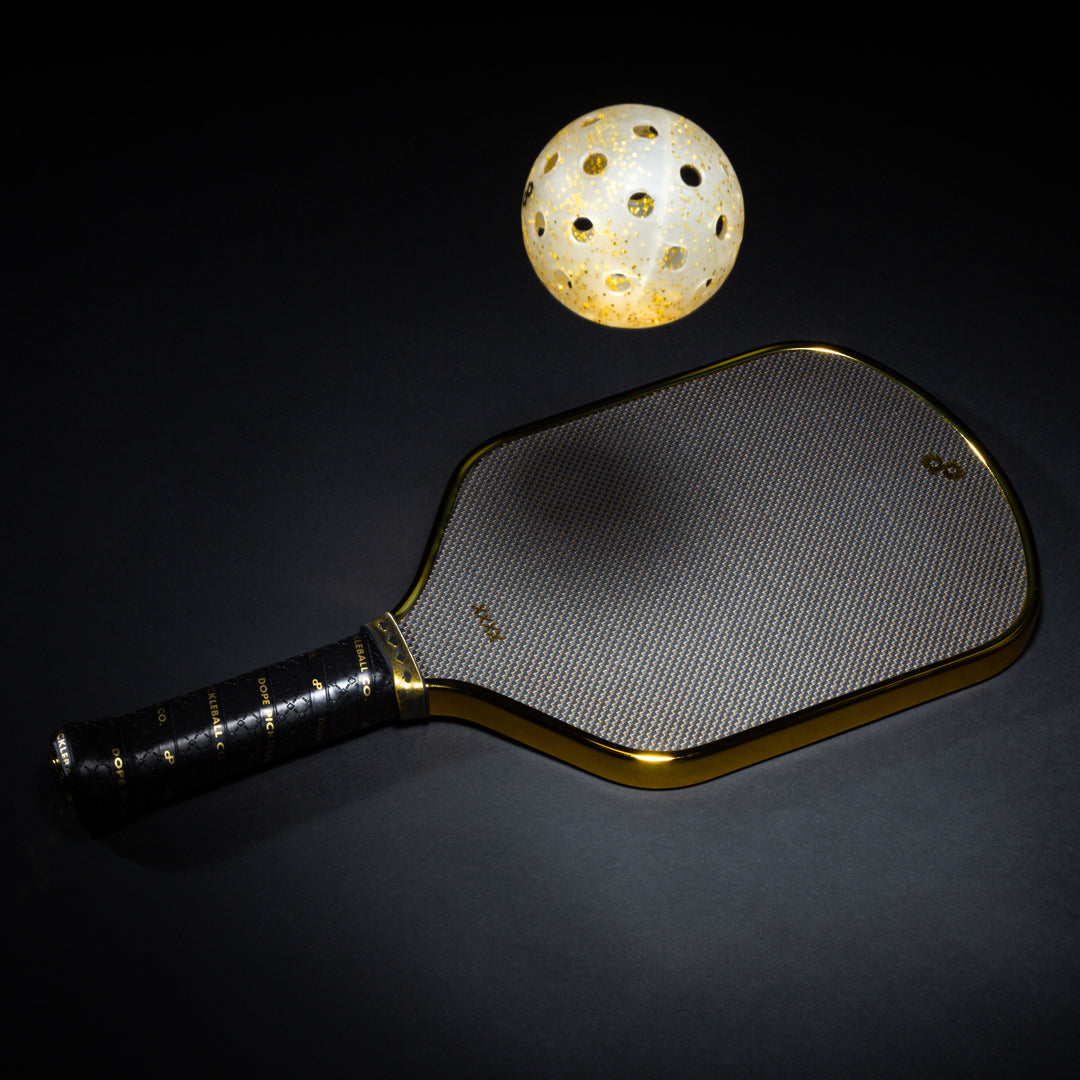
The Pink & Yellow Glitter-Infused Bundle offers multiple balls for repetition, while the High Roller Gold 4-Pack matches the black-and-gold collection. Choose ball color for court contrast and check current product pages for availability.
The High Roller Chrome Gold Paddle is a recreational or unsanctioned-play option where permitted. It is not USA Pickleball approved. Equipment cannot replace spacing, trajectory, or decision practice.
Frequently Asked Questions
What is a third-shot drop in pickleball?
It is a soft, arcing third ball from the serving team intended to descend into the kitchen and reduce the opponents’ attack height.
Should you always hit a third-shot drop?
No. Return depth, contact quality, opponent position, and team strengths may make a drive, drop, lob, or higher-margin ball more appropriate.
Where should a third-shot drop land?
Aim for a kitchen target that creates a low opponent contact. Middle, crosscourt, a foot, or a moving player can each be useful.
Why does a third-shot drop pop up?
Common causes include an overly open face, late contact, abrupt lift, poor spacing, and too much upward speed.
When should you move forward after a drop?
Advance together when the ball is low and descending, hold on an uncertain ball, and defend when the drop sits up.
Share:
How to Practice Pickleball Alone: Complete Solo Drill Guide
5 Bad Pickleball Habits Costing You Points—and How to Fix Them